> ## Documentation Index
> Fetch the complete documentation index at: https://docs.bango.com/llms.txt
> Use this file to discover all available pages before exploring further.
# Updating an entitlement
> Making sparse updates to an existing entitlement
In the Bango Platform, entitlements describe a user's ability to access a service provided by a merchant. To make changes to an existing entitlement, you send a `PATCH` request to the Bango Resale API.
You can't cancel, or revoke entitlements using `PATCH` requests: a `PATCH` **can't change the `status` property to `CANCELLED` or `REVOKED`**. Use the more specific [cancel](/legacy/resale/reseller/entitlements/cancel) or [revoke](/legacy/resale/reseller/entitlements/revoke) API requests instead.
As part of the API request, you supply:
* The entitlement ID.
* Other entitlement properties you want to change, such as `notificationUrl`, `dateExpiry`, or any custom `extensionData`. See [Bango Resale / For resellers / Reseller API reference / Reseller API reference overview](/legacy/resale/reseller/api-ref/index).
You can suspend, or resume entitlements using `PATCH` requests. For more information see [suspend](/legacy/resale/reseller/entitlements/suspend) or [resume](/legacy/resale/reseller/entitlements/resume).
You can reverse a cancellation before the `dateEnded` is reached using `PATCH` requests. For more information see [cancel](/legacy/resale/reseller/entitlements/cancel).
The API response is a structure that contains:
* A response code, indicating the result of the request. Use this code to determine what to do next.
* For HTTP 2xx responses, the entitlement record.
Depending on merchant requirements and potentially other factors, the response code might indicate that your code needs to take some action as a result of the update request. For example, the update might require the user to visit a web page to perform a process. In this case the entitlement record returned contains your requested updates but with status `PENDING`, and any later change to status `ACTIVE` is `POST`ed to the entitlement's `notificationUrl`, if specified.
### Sequence diagrams
The Bango Platform updates the entitlement and the user does not have to perform a process. The entitlement status does not change.
 The merchant requires the user to perform a process. The Bango Platform returns an updated entitlement with status `PENDING`, with the response code `CLIENT_ACTION_REQUIRED` and action `NAVIGATE_TO_URL`, together with the target URL. You send the user to the URL, and when the user completes the process the Bango Platform notifies you by direct server-to-server communication.
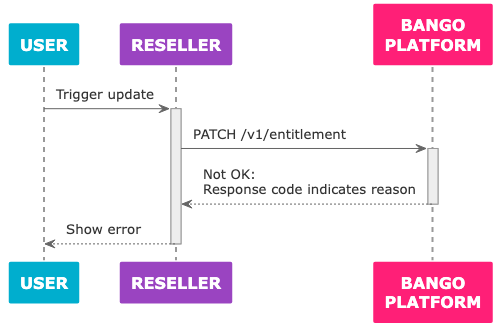
The Bango Platform can't update the entitlement, and returns the reason in the response to the API request.
### Skeleton code
Here's some sample code in a C/Java-like language: adapt this code to your needs. Use the same API endpoint prefix with test credentials and with production credentials.
Some functions referenced in the skeleton code, such as `redirect_device_to`, are not defined. You need to implement these where possible.
```text theme={null}
function update_entitlement (entitlement_id, properties_to_update = {}) {
// *Always* use this endpoint prefix for the Bango Resale API.
const base_url = "https://resale.api.bango.net";
// This is what's returned with HTTP 2xx.
let entitlement = null;
// The entitlement ID is passed in the body not the path.
// Here, assume properties_to_update is a map of entitlement
// property names to values.
// See API ref for details of which properties you can update.
const request_body_params = properties_to_update
.copy()
.set('entitlementId', entitlement_id);
try {
// PATCH UTF-8 JSON to the Bango Resale API and parse the JSON response
let response = rest_client_call({
method: "PATCH",
url: base_url + "entitlement",
headers: {
"Authorization": get_authorization_header(),
"Content-Type": "application/json",
},
body: make_json_string(request_body_params),
}).from_json();
// The responseCode tells us the result.
switch (response.responseCode) {
// Success: no action required
case "OK":
entitlement = response;
break;
// More to do: The reseller must take action
case "CLIENT_ACTION_REQUIRED":
// This response parameter tells us what we need to do.
switch (response.parameters.action) {
case "NAVIGATE_TO_URL":
// Send the user to a particular web page
// to complete a merchant-defined process.
// Set entitlement's notificationUrl to
// receive notification of entitlement
// changes asynchronously.
redirect_device_to({
url: response.parameters.url,
});
// Updated entitlement is returned in this case
// but with status PENDING.
entitlement = response;
break;
default:
// Unrecognized action.
// Check the documentation again.
throw "Unrecognized client action";
}
break;
// Failures
// These may indicate issues in your code, not the Bango Platform.
case "BAD_REQUEST": // Invalid request
case "UNAUTHORIZED": // Check your credentials
case "NOT_AVAILABLE": // Unable to update this entitlement
case "NOT_FOUND": // Invalid entitlement ID
case "TOO_MANY_REQUESTS": // Request limit reached: try again later
throw "Unable to update entitlement";
// Bango Platform issues
// These likely indicate transient problems.
// In production code, you might want to try the request again
// after a delay, ultimately falling back to an error state.
case "INTERNAL_ERROR":
case "SERVICE_UNAVAILABLE":
throw "Bango Platform unavailable";
// This might indicate Bango has added a new response code.
// Check the documentation again.
default:
throw "Unrecognized response code";
}
} catch (exception) {
// Production code might want to notify the reseller in some way,
// and/or log full details of the exception for later analysis,
// and degrade gracefully for the user.
output("An error occurred!");
output(exception);
}
// null if entitlement not updated.
// if updated, will have an entitlementId, status, and other properties:
// see API reference.
return entitlement;
}
```
### FAQ
You must set the `entitlementId`. Include any other parameters you want to update: any parameter not included in the request is not changed.
See [Bango Resale / For resellers / Reseller API reference / Reseller API reference overview](/legacy/resale/reseller/api-ref/index) for detailed information on all request parameters.
It depends on the merchant, the user, the service, and possibly other factors. In most cases you won't have to do anything: the update request will return the response code `OK`.
One likely reason for the response code `CLIENT_ACTION_REQUIRED` may be a change in `productKey`: perhaps you're upgrading the user to a new service tier, and the merchant requires an additional setup process.
All responses contain a `responseCode` string that indicates the result of the request. Use this code to determine how to react. For each distinct `responseCode`, the response might include other useful values.
See [Bango Resale / For resellers / Reseller API reference / Reseller API reference overview](/legacy/resale/reseller/api-ref/index) for detailed information on all responses.
The merchant requires the user to perform a process. The Bango Platform returns an updated entitlement with status `PENDING`, with the response code `CLIENT_ACTION_REQUIRED` and action `NAVIGATE_TO_URL`, together with the target URL. You send the user to the URL, and when the user completes the process the Bango Platform notifies you by direct server-to-server communication.
The Bango Platform can't update the entitlement, and returns the reason in the response to the API request.
### Skeleton code
Here's some sample code in a C/Java-like language: adapt this code to your needs. Use the same API endpoint prefix with test credentials and with production credentials.
Some functions referenced in the skeleton code, such as `redirect_device_to`, are not defined. You need to implement these where possible.
```text theme={null}
function update_entitlement (entitlement_id, properties_to_update = {}) {
// *Always* use this endpoint prefix for the Bango Resale API.
const base_url = "https://resale.api.bango.net";
// This is what's returned with HTTP 2xx.
let entitlement = null;
// The entitlement ID is passed in the body not the path.
// Here, assume properties_to_update is a map of entitlement
// property names to values.
// See API ref for details of which properties you can update.
const request_body_params = properties_to_update
.copy()
.set('entitlementId', entitlement_id);
try {
// PATCH UTF-8 JSON to the Bango Resale API and parse the JSON response
let response = rest_client_call({
method: "PATCH",
url: base_url + "entitlement",
headers: {
"Authorization": get_authorization_header(),
"Content-Type": "application/json",
},
body: make_json_string(request_body_params),
}).from_json();
// The responseCode tells us the result.
switch (response.responseCode) {
// Success: no action required
case "OK":
entitlement = response;
break;
// More to do: The reseller must take action
case "CLIENT_ACTION_REQUIRED":
// This response parameter tells us what we need to do.
switch (response.parameters.action) {
case "NAVIGATE_TO_URL":
// Send the user to a particular web page
// to complete a merchant-defined process.
// Set entitlement's notificationUrl to
// receive notification of entitlement
// changes asynchronously.
redirect_device_to({
url: response.parameters.url,
});
// Updated entitlement is returned in this case
// but with status PENDING.
entitlement = response;
break;
default:
// Unrecognized action.
// Check the documentation again.
throw "Unrecognized client action";
}
break;
// Failures
// These may indicate issues in your code, not the Bango Platform.
case "BAD_REQUEST": // Invalid request
case "UNAUTHORIZED": // Check your credentials
case "NOT_AVAILABLE": // Unable to update this entitlement
case "NOT_FOUND": // Invalid entitlement ID
case "TOO_MANY_REQUESTS": // Request limit reached: try again later
throw "Unable to update entitlement";
// Bango Platform issues
// These likely indicate transient problems.
// In production code, you might want to try the request again
// after a delay, ultimately falling back to an error state.
case "INTERNAL_ERROR":
case "SERVICE_UNAVAILABLE":
throw "Bango Platform unavailable";
// This might indicate Bango has added a new response code.
// Check the documentation again.
default:
throw "Unrecognized response code";
}
} catch (exception) {
// Production code might want to notify the reseller in some way,
// and/or log full details of the exception for later analysis,
// and degrade gracefully for the user.
output("An error occurred!");
output(exception);
}
// null if entitlement not updated.
// if updated, will have an entitlementId, status, and other properties:
// see API reference.
return entitlement;
}
```
### FAQ
You must set the `entitlementId`. Include any other parameters you want to update: any parameter not included in the request is not changed.
See [Bango Resale / For resellers / Reseller API reference / Reseller API reference overview](/legacy/resale/reseller/api-ref/index) for detailed information on all request parameters.
It depends on the merchant, the user, the service, and possibly other factors. In most cases you won't have to do anything: the update request will return the response code `OK`.
One likely reason for the response code `CLIENT_ACTION_REQUIRED` may be a change in `productKey`: perhaps you're upgrading the user to a new service tier, and the merchant requires an additional setup process.
All responses contain a `responseCode` string that indicates the result of the request. Use this code to determine how to react. For each distinct `responseCode`, the response might include other useful values.
See [Bango Resale / For resellers / Reseller API reference / Reseller API reference overview](/legacy/resale/reseller/api-ref/index) for detailed information on all responses.